
James Gazzale
Seeing the race shape matters more than simply naming the “best” runner
In handicapping, the trickiest job often isn’t flagging the most talented entrant; predicting the unfolding pace is. Who is likely to seize command right after the break, and who ends up pressing or sitting just off? When will the decisive move actually happen—on the turn or late inside the final furlong—and by which runner? For example, an outer-drawn speed type might gun early, while a deep closer can be bottled up behind rivals.
That exact puzzle is the reason Pace Points came into existence, created to address it head‑on.
In essence, Pace Points is a data tool built to strip away clutter around early foot and finishing power relative to the group. Instead of eyeballing scattered running lines or mentally normalizing fractions across different circuits and class bands, the system ranks who profiles to attend the pace early and who is projected to finish strongest for the specific race you’re tackling; think of it like a quick map of expected pressure and late strength.
👉 For a deeper look at how Pace Points is derived and used, visit the Pace Points page on .
A clean illustration emerged on Oaklawn Park’s opening weekend in the Ring the Bell Stakes. On paper there wasn’t an obvious pace commander; several entrants had flashed speed at various points in their careers, yet none screamed “solo leader” from a cursory review of PPs—for instance, one had sprint speed but another showed route pace.
Pace Points revealed a contrasting picture
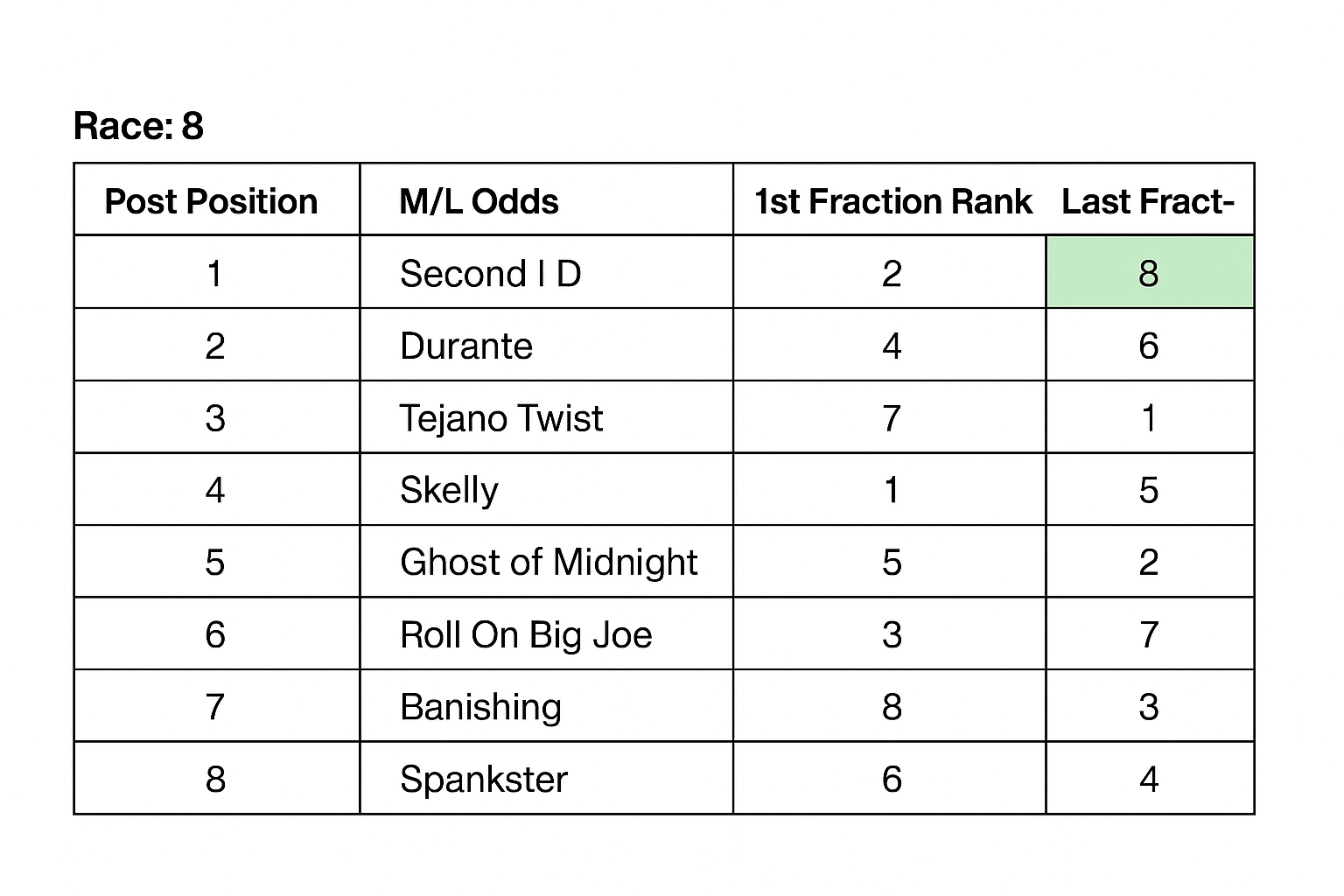
The early projections isolated a compact cluster expected to supply pace pressure. When the latch sprang, that view largely materialized: one runner left awkwardly, another got shuffled, and Roll On Big Joe landed the golden trip—up front, unpressured, and traveling comfortably, much like a sprinter allowed to breathe on the lead.
Early placement reshaped the outcome
Despite a modest position on the late‑pace scale, Roll On Big Joe controlled proceedings by rationing energy efficiently. He reached the stretch with daylight, and although Banishing and Tejano Twist uncorked rallies, the gap was simply too wide to bridge, as often happens when closers chase honest splits.
Here’s the takeaway when using Pace Points: early and late rankings are not finish‑order predictions. They are instruments to visualize race shape, anticipate trip dynamics, and estimate energy distribution; in other words, they help sketch the likely script and pace scenario.
👉 To spot pace edges before race day, explore the full Pace Points product on .
Late punch only matters if a runner is situated to deploy it. In this case, the data explained why a big kick wasn’t required from the winner; the result was effectively decided within the opening third of a minute.
Pace Points is most powerful alongside your standard workflow. Blend it with past performances, video replays, draw/post considerations, and class evaluation—plus trip notes or even speed figures—and the picture snaps into focus; instead of reacting afterward, you begin anticipating what is most likely to occur.
That outcome is the aim.
👉 Ready to add Pace Points to your toolkit? Visit to see how early and late pace rankings can deliver a clearer edge, and when you can picture the race in advance, your betting decisions improve at the window.

Michael Dempsey