
James Gazzale
Built to benchmark entrants against their rivals across two race slices—the break‑to‑first call and the drive to the wire—Pace Points operates as a relative scale. Rather than declaring an exact finish order, the tool sketches a probable pace scenario before the latch springs (e.g., which runner might seize the front versus who projects to close).
In handicapping, pinpointing talent is often easier than foreseeing how the event will flow. What needs mapping is the likely choreography and the probability of different flows. Here, Pace Points provides that map, and the Harlan’s Holiday Stakes, run at Gulfstream Park, illustrated—almost by the book—how early and late ratings tighten the view (think a pressured lead versus a measured finish).
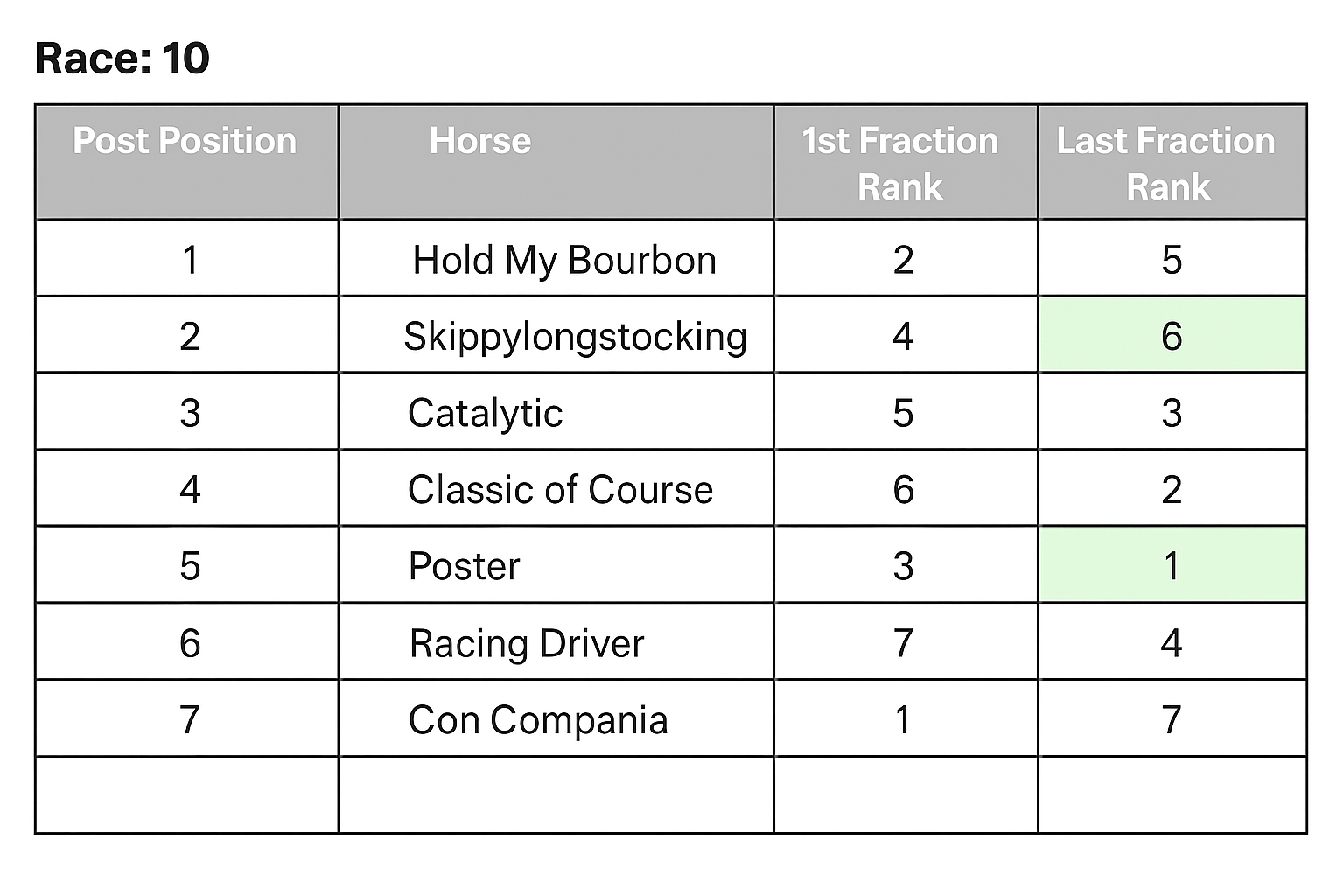
Within the Harlan’s Holiday, early Pace Points hinted at a hot front end. Hold My Bourbon, Con Compania, and Skippylongstocking figured to attend the pace from the jump. The immediate dilemma became this: does the pressure crack the leaders, or can a pace‑setter ration energy and take command (e.g., a gate‑to‑wire try)?
Race replay footage would appear at this point (for instance, a standard YouTube embed).
From the inside draw, Hold My Bourbon was sent aggressively, addressing one side of the puzzle immediately. Yet the risk had been signposted by Pace Points. Although graded well for the break, his staying profile looked thin, and when the clock read roughly twenty‑two and a tick with the half under forty‑six seconds, vulnerability became visible; that tempo tends to reel in speed (e.g., multiple stalkers lining up).
At the opposite pole was Poster, sitting atop the late Pace Points table. On form, a swift first half set him up perfectly. Through much of the lane, the script indeed looked like a closer’s dream (classic collapse pattern).
Still, the framework also shows why an apparent closer sometimes fails to arrive on time (for example, when flow shifts mid‑turn).
Another replay placeholder would reside here (e.g., the same race video panel).
Skippylongstocking, though not lofty on the late scale, landed a perfect journey: he kept close, saved ground around the bend, and made the initial move. Poster, by contrast, had to swing out; that extra path—small but real—proved the separator. With ability comparable, path economy can equal pure finishing kick (e.g., one lane tighter equals a neck).
Essential takeaway: Pace Points augment, rather than supplant, traditional handicapping; late numbers pointed to Poster as the best closer, and the early read flagged the pace architects, while the outcome hinged on how those forces met in live running.
For bettors, this perspective can cut needless spread, focus bankroll, and clarify where the variance hides—especially in stakes scenes with razor‑thin edges and compressed odds (e.g., Grade 3 lines).
If you’d like to see how Pace Points are assembled and put to work in your own process, go to /Pace-Points for a deeper look; there you’ll find step‑by‑step explanations and worked examples similar to this case (sample cards, case studies).
The Harlan’s Holiday confirmed the Pace Points read rather than disputing it. The figures highlighted the pressure points, the likely finishers, and the soft spots. What remained fell to trip, timing, and execution (e.g., rider decisions).
To dig into how Pace Points can sharpen race analysis and ticket design, visit /Pace-Points and gauge how the tool meshes with your routine. As contests like the Harlan’s Holiday remind us, grasping pace is preparation, not prophecy (trip notes help).
Learn more about Pace Points and begin using it today at /Pace-Points (start with a single race, for example).

Michael Dempsey